Now on Amazon Β· First edition 2026

Everyone tells you to shrink it.
Nobody tells you by how much.

Your Carbon Footprint is a 23-chapter, fully-referenced guide to measuring and reducing your environmental impact β€” built on peer-reviewed emission factors, not vibes. 58 data tables. Five real case studies. A 30-day plan. Ten languages.

Kindle & paperback Β· English and French available now Β· Eight more editions coming

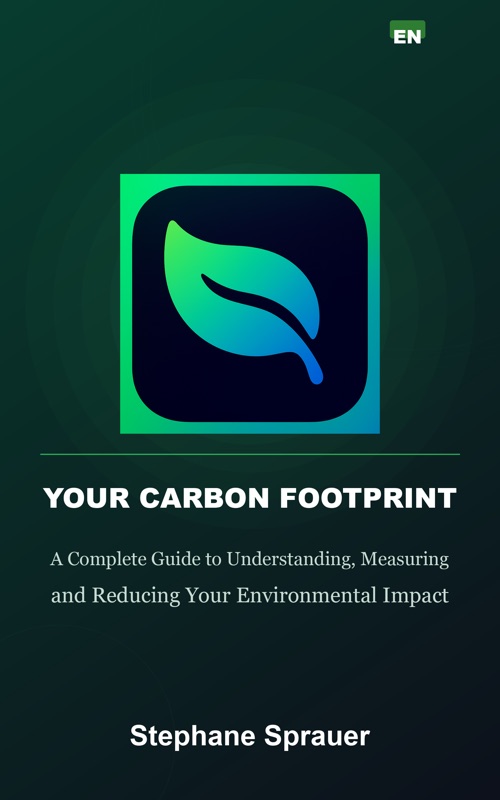
Your Carbon Footprint by Stephane Sprauer β€” book cover
23Chapters, front-loaded with data
58Referenced data tables
10Full language editions
30Day carbon detox plan
The problem, stated honestly

You are probably emitting five to seventeen times your fair share.

The Paris Agreement implies a personal budget of roughly 2 tonnes of COβ‚‚e per year β€” about 5.48 kg a day. Here is how that compares to where most people actually are.

Paris-compatible target
2.0 t
Global average today
6.0 t
United States average
16.0 t
Australia average
17.0 t
The carbon budget in plain language. For a 50% chance of staying below 1.5 Β°C, the remaining global budget is roughly 400 billion tonnes of COβ‚‚. Current emissions run at about 55 billion tonnes a year β€” around seven years of budget. That does not mean disaster in seven years. It means emissions must fall now, rapidly and consistently, not stop at some future date.
Chapter 2B Β· Life in a warming world

The difference between 1.5 Β°C and 3 Β°C is not a number.

It is the difference between difficulty and catastrophe for billions of people. Most books leave warming as an abstraction. This one gives an entire chapter to what each fraction of a degree actually does β€” to crops, coastlines, water, and the temperature at which outdoor work becomes medically dangerous.

Impact domainAt +1.5 Β°C

Scenario figures are drawn from IPCC assessment reports and the peer-reviewed impact literature, as compiled in Chapter 2B.

β€œBehind each fraction of a degree lies a cascade of specific, human-scale consequences: the frequency with which a farmer in Maharashtra loses her crop to drought, the height of floodwater in a Bangkok apartment building, the temperature at which outdoor labor becomes medically dangerous in Phoenix.”
Chapter 2B β€” Life in a Warming World
The data

Numbers precise enough to actually decide with.

Every emission factor in the book traces to a published source. Two of the 58 tables, reproduced here in full.

How you move

Grams of COβ‚‚e per passenger-kilometre

Sources: EEA, IPCC, manufacturer LCA reports. Aviation includes a ~2Γ— radiative forcing multiplier for contrails, water vapour and NOβ‚“ at altitude.

Protein, per unit of carbon

Grams of protein delivered per kg COβ‚‚e β€” higher is better

Primary source: Poore & Nemecek (2018), global averages from peer-reviewed lifecycle assessments.

6.0 kg200 g beef burger
β†’
0.18 kg200 g lentil burger or dhal
The single most impactful swap in the book. Doing this twice a week saves ~600 kg COβ‚‚e a year β€” 30% of the entire Paris-compatible annual budget, from one recurring decision.
Making the numbers real

A tonne of COβ‚‚e means nothing until you can picture it.

92 treesWhat it takes to absorb your entire 2-tonne annual budget. One tree absorbs about 21.77 kg COβ‚‚e a year.
2.8 tonnesA return flight London–New York, per passenger. More than an entire year's sustainable budget from one trip.
8.7 tonnesA return flight London–Sydney, per passenger β€” four times the annual budget.
13 kmDriving distance equivalent to one beef hamburger (~2.5 kg COβ‚‚e).
85 kgManufacturing a single smartphone β€” about four trees' annual absorption.
65 : 1The ratio between the highest- and lowest-emission common foods: beef at 29.9 kg/kg, vegetables at 0.5.
What you'll actually learn

From the science to your Saturday shopping list.

Most climate books stop at the problem. This one starts there and keeps going β€” into your plate, your commute, your thermostat, your wardrobe, and then into a plan you can follow.

01

Measure honestly

How scientists actually calculate emissions, what an emission factor is, how to build a personal baseline β€” and why most online calculators mislead.

02

Food, in forensic detail

A complete food emissions guide covering 19 seafood types, fermented foods, seasonal produce and protein efficiency β€” plus a practical roadmap for changing what you eat.

03

Every way you move

Twelve transport modes compared per kilometre, real EV models with real grid intensities, manufacturing footprints, and where rail genuinely beats flying.

04

The home you heat

Heating sources ranked by COβ‚‚e per kWh, heat pump versus gas boiler over 15 years, grid intensity by country, insulation, solar and storage.

05

Everything you own

Embodied carbon in phones, laptops, appliances, furniture and clothing β€” and what the circular economy actually saves, material by material.

06

A plan, then leverage

A personal carbon budget, a 30-day detox, a year-by-year trajectory β€” then the chapter on where individual action stops and systemic change takes over.

Read before you buy

Four passages, unedited.

Chapter 1 β€” What Is a Carbon Footprint?

The specific phrase "carbon footprint," referring to greenhouse gas emissions, gained widespread currency in the early 2000s β€” and its popularization is entangled with a controversial chapter in corporate history. The oil company BP ran a major advertising campaign between 2004 and 2006 that introduced a "carbon footprint calculator" to the public and encouraged individuals to calculate and reduce their personal emissions. The campaign was criticized by climate activists who argued it shifted responsibility from the fossil fuel industry onto individuals, making consumers feel personally culpable for problems caused by structural forces far beyond any one person's control.

Chapter 2 β€” The Climate Crisis in Numbers

Here is one way to think about it: if you stacked 55 billion tonnes of COβ‚‚ in solid blocks, each the size of a shipping container, the stack would stretch from Earth to the Moon and back β€” many times over. Every year. Without pause. That is what our global economy emits, continuing a trend that has accelerated almost without interruption since the first coal-fired steam engine began turning wheels in eighteenth-century Britain.

Chapter 5 β€” The Hidden Emissions on Your Plate

At the personal level, food is typically the single largest or second largest contributor to an individual's carbon footprint, depending on how much they fly. For someone who does not travel by air frequently, food is almost certainly the number one lever. And unlike home heating or transport infrastructure β€” which often require significant capital investment or depend on unavailable alternatives β€” diet is something most people in wealthy nations have the ability to change right now, today, with little cost and potentially significant co-benefits for health and wellbeing.

Chapter 19 β€” Community, Advocacy, and Systemic Change

Individual action is necessary but not sufficient. The carbon budget numbers make this mathematically clear: even if every person in the developed world adopted the most aggressive individual lifestyle changes available β€” vegan diet, no flying, electric car, heat pump, maximum insulation β€” the resulting emission reductions would be significant but would still fall short of the 1.5 Β°C target without concurrent system-level change.

Chapter 17 Β· Building your personal carbon budget

The ten highest-leverage actions, ranked and costed.

The 80/20 rule applies to carbon. A small number of changes delivers 50–60% of the achievable reduction β€” and several of them save money rather than costing it.

ActionAnnual savingDifficultyCost
Appendix Β· Five composite portraits

The same advice does not work for everyone.

Five people, five countries, five completely different highest-impact actions. The book walks each through a multi-year trajectory with real numbers.

Sarah
Denver, USA Β· marketing manager
24.5 β†’ 10 tover five years

A large SUV, a big suburban house and a meat-heavy diet. Year one is diet and tariff; the capital investments β€” EV, solar, heat pump β€” come later. A 59% cut, still not at target, but profound.

Ahmed
London, UK Β· software developer
61%of his footprint is flying

No car, mostly vegetarian, flat-share β€” the "environmentally friendly" life. Four international flights a year swamp all of it. His case proves the highest-impact action is rarely the obvious one.

Maria
Rural Bavaria, Germany Β· teacher
Heatingand diet dominate

No public transit, an old petrol Golf, a gas-heated village house. German BAFA grants and KfW loans make the heat pump the decisive move β€” capital, not willpower.

James
Sydney, Australia Β· consultant
15.3 tof 27 t, from flights

Twelve domestic and four international flights a year, all work. He cannot unilaterally stop. His chapter is about employer-level change, not personal virtue.

Lin
Singapore Β· financial analyst
Contextchanges the maths

Already low, thanks to the MRT and no car. Her air conditioning is not a luxury but a climate necessity β€” a reminder that identical behaviour carries different costs in different places.

And then, you.

Chapter 4 builds your own baseline; Chapter 17 turns it into a year-by-year budget; Chapter 18 gets you started in 30 days.

Where the numbers come from

Every emission factor is traceable.

The book is an act of translation, not invention. These are the datasets underneath it β€” all of them public, all of them checkable.

Food emissions

Kilograms of COβ‚‚e per kilogram of food, as global averages from peer-reviewed lifecycle assessments across thousands of farms.

Primary source: Poore & Nemecek (2018)

Transport emissions

Grams of COβ‚‚e per passenger-kilometre. Aviation figures include the radiative forcing multiplier of roughly 2Γ— for contrails, water vapour and NOβ‚“ at altitude.

Sources: EEA, IPCC, manufacturer LCA reports

Energy & heating

Grams of COβ‚‚e per kilowatt-hour of useful heat or electricity delivered, with national grid intensities given country by country.

Sources: IEA, Ecoinvent, national energy agency reports

Embodied carbon in goods

Lifecycle embodied carbon from raw material extraction through manufacturing and assembly, for phones, laptops, appliances and furniture.

Sources: Apple, Samsung, Google environmental reports; Ecoinvent; Carbon Trust

National footprints

Annual COβ‚‚e per capita on a consumption basis β€” imports and exports allocated to the country of consumption, not production.

Sources: Our World in Data, Global Carbon Project, World Bank (2023–24)

Greenhouse gas warming potentials

COβ‚‚e conversion on a common warming scale: methane at 25Γ—, nitrous oxide at 298Γ— over 100 years β€” which is why beef scores so high without burning fossil fuel directly.

Source: IPCC assessment reports
Table of contents

Twenty-three chapters, from first principles to 2050.

  • 1What Is a Carbon Footprint?
  • 2The Climate Crisis in Numbers
  • 2BLife in a Warming World β€” What Each Degree Really Means
  • 3How Scientists Measure Emissions
  • 4Understanding Your Personal Baseline
  • 5The Hidden Emissions on Your Plate
  • 6The Complete Food Emissions Guide
  • 7Transforming Your Diet β€” A Practical Roadmap
  • 8How We Move and Why It Matters
  • 9Your Car's Carbon Story
  • 10Flying, Public Transit, and the Future of Travel
  • 11Heating, Cooling, and Your Energy Bill
  • 12The Road to a Zero-Carbon Home
  • 13Electricity, Renewables, and the Grid
  • 14The True Cost of Everything You Own
  • 15Fashion, Clothing, and Textiles
  • 16The Circular Economy β€” Buy Less, Buy Better
  • 17Building Your Personal Carbon Budget
  • 18The 30-Day Carbon Detox Plan
  • 19Community, Advocacy, and Systemic Change
  • 20Emerging Technologies That Could Save Us
  • 21A Vision for 2050
  • 22Decarbonr β€” The App That Powers This Book
  • AAppendices β€” reference tables, five case studies, further reading
Ten editions

Written once. Translated in full, ten times.

Each edition is a complete translation β€” not a summary β€” as a Kindle eBook and a paperback. English and French are available now; the remaining eight are on their way.

About the author

Stephane Sprauer

A software developer, entrepreneur, and advocate for accessible climate science. He is the creator of Decarbonr, an iOS app that helps thousands of people track and reduce their daily greenhouse gas emissions through a data-driven interface.

"The data exists. The challenge is making it accessible β€” turning scientific emission factors into something you can actually use at breakfast."

His interest in carbon accounting grew from a conviction that the complexity of climate science was keeping most people from engaging meaningfully with the problem. Decarbonr was born from that conviction: peer-reviewed emissions data in the hands of anyone with a smartphone, no environmental science degree required. This book is the next step β€” the context, the science, the specific numbers, and the practical steps, in one volume.

French edition β€” Votre Empreinte Carbone
Honest answers

Before you buy.

Is this another book telling me to feel guilty?
No. Chapter 1 opens by explaining that the phrase "carbon footprint" was popularised by an oil company campaign that shifted blame onto consumers β€” and Chapter 19 states plainly that individual action alone cannot hit the 1.5 Β°C target. The book's position is that individual and systemic change are both necessary and not in opposition.
Do I need a science background?
No. Every technical term is defined where it first appears, and every number is translated into something physical β€” trees, kilometres driven, days of television. The data is rigorous; the reading is not.
How current are the figures?
Emission factors are drawn from the most recent published datasets available at the time of writing, with national footprint data from 2023–24 and grid intensities from current national energy agency reporting. Where a figure is a range or an estimate, the book says so.
Is the paperback the same content as the Kindle edition?
Yes β€” identical text, tables and appendices. The print interior is typeset for the page; the Kindle edition reflows.
When will the other eight languages be available?
German, Spanish, Italian, Portuguese, Dutch, Danish, Norwegian and Swedish editions are written and typeset. They publish progressively β€” this page updates as each goes live.
Do I need the Decarbonr app to use the book?
No. The book is complete on its own; Chapter 22 describes the app for readers who want ongoing tracking, but every calculation in the book can be done with a pen.

Stop guessing. Start measuring.

Twenty-three chapters, fifty-eight data tables, and a plan that starts tomorrow morning.